Convergent Ambiguities: From Slime Mold to Temporary Autonomous Architecture
Ambiguous: from Latin ambiguus "having double meaning, shifting, changeable, doubtful," adj. derived from ambigere "to dispute about," lit. "to wander," from ambi- "about" + agere "drive, lead, act".
Convergence: 1960s, from Latin convergere "to incline togheter" from com- "togheter" + vergere "to bend".
The City and The City is a book about borders, mental separation, illusion and ambiguities generated by the existence of two cities in the same body.
Slime mold (Physarum Polycephalum) is a biological organism that also has many ambiguities: it categorizes as a protist, it is a single cell organism but it contains multiple nucleuses, it shows complex behaviors despite its simple structure.
“Anonymous” is a cyber-activist collective based on self-organization and on the doubling of the identity, operated by its own members in order to remain “anonymous”.
This project draws inspiration from all these ambiguities and tries to create a new kind of architecture able to express them rather than eliminate dualities. It explores the world of biological organisms not as simple metaphors but as a repertoire of active production systems. The project also relies on the concept of “Temporary Autonomous Zone” (TAZ), defined as a momentary space of liberation from the control grid of the contemporary society, a space of continuous insurrection and change.
Situated in the near future, where censorship and repression are harming the freedom and the self-organized nature of the biggest network ever built by humans, the World Wide Web, we envisioned an architecture able to host the operations of the rebels of the new millennium.
The network logic derived from Slime Mold informs the creation of a virtual communication network between the different abandoned buildings of the IBA area, transforming them into pulsating nodes of an alternative topography of insurrection, hiding them and at the same time connecting them to the common world trough the virtual realm of the internet.
The nodes created become the place of birth of a new kind of architecture: non-planned, self-growing and self-sustaining, these “living organisms” could shelter the hacktivists in their foldings, offering at the same time a protection and the possibility of renegotiating the relationship between human, nature and architecture.
The materials of this architecture are not just inspired by biology, but they are biological by themselves, and the encoding of Internet protocols into protein chains and chemical gradients creates a biological firewall against intrusions in the virtual network of the rebels. The biological nature of the system itself accepts time and temporality as positive drivers of change and adaptation to different flows of matter and energy.
In all this, the project tries to create a vision, in which the architecture abandons its inert nature, in order to open itself to a positive dialogue between nature and the humankind, between the real and the virtual, between reality and Utopia, between “biophilia” and “technophilia”.
CodesInTheClouds design studio - prof. Liss C. Werner
Dessau Institute of Architecture
Slime Mold team: Lila Panahi Kazemi, Andrea Rossi
Synthetic Ornament is an exploration in the realms of ornamentation, aesthetics, physical computing, prosthetics and fashion technology. It’s an attempt to understand the underlying logics of ornamentation, both in natural and in cultural systems, and to apply them in a prototypical project of an interactive piece of clothing, intended as a way to blur the borders between body and technological extensions.
The aim is to overcome superficial judgments on this theme and to explore the real implication of the renewed interest in ornament and in its theoretical concerns, especially in relation to the advent of the digital design techniques in the design world[1]. The aesthetics at the base of this thrive to complexity, articulation and interconnection of the parts, looking at the gothic and the baroque as seminal moments of coherent fusion between structure and ornament.
Final objective of the design phase is the creation of an “ornamental organism”, an interactive system with the scope of generating aesthetic pleasure in the observers, consciously refusing any other function and even partially inhibiting some functions of the user. As to say, beauty at any cost.
From Nature to Society
Ornament is a complex, contradictory and often misunderstood term: in biological terms, ornament is defined as “a structure of an animal that appears to serve a decorative function rather than an ostensible, utilitarian function.”[2]. This stresses the non-utilitarian function of this element, also if just in a superficial way. As Darwin showed[3], most of the ornamental strategies developed in the biological world are closely linked with sexual selection and reproduction, being mainly destined to attract mates.
But, beside this, the study of animal behavior show many interesting uses of ornamental devices: from communication between mates (cuttlefish), to diet responses (nudibranches), to seasonal changes and camouflage (many species of mammals and reptiles), to even “mood” communication (chameleon). All these clearly show as in nature is really rare to find any element that has a purely ornamental value, completely disconnected from any practical living necessity.
The concept of ornament assumes a totally different importance and meaning in the human society. According to Michael Weinstock, “personal ornaments are visual displays that convey information to outsiders, indicating the membership of a specific group, and more personal information such as married status or adulthood”[4]. Indeed, in human culture ornamentation becomes a central point when it comes to define the identity of a person or of a social group, and in this way these forms without function assume many complex and interrelated values.
More than this, the ornament become, as soon as the human developed an aesthetic sensibility, one of the centers of generation of the aesthetic experience. Considering the aesthetic dimension as “a moment in which the form production of morphogenetic systems generate patterns that interfere with cultural systems, shaping and influencing them, and getting themselves influenced by these”[5], the ornament shows a clear productive capacity and a complex and interactive behavior, that links together form generation, culture development and social values.
From ‘Purism’ to ‘Exuberance’
In architecture, the ornament always assumed a high relevance, especially in periods like the gothic and the baroque, and it has been the preferred vector for the diffusion of moral and ethical values to the masses. The modern movement “purification of form” pushed the ornament aside for almost a century, but in the last years the advent of the digital tool and the increases in complexity and articulation allowed by these brought ornamentation issues back in the center of the architectural discourse.
“The system seemed to open up, to become more inclusive; more interpolated, inquisitive, impatient; more Baroque, even Rococo (Rococo being the feminine moment of the Baroque). And more excessive, extravagant, exuberant. Thus Exuberance turned into a manifesto. Of the pervasiveness of phenomenological aspects of digitality, of the varied approaches towards digital design, of the non-engineered intelligence of digital space, of the profuseness of digibio-techno ornamentation, of the abundance of CGI in Hollywood, of the excessiveness of computer games, of the lavishness of Middle Eastern and Asian super-urbanism. But also of fluidity and elegance, of a rather sinister neo-Jugendstil revival, even of a neo-Rococo ‘prettynisation’ of the digital”[6].
This strong and sudden return of the ornamentation into the architectural theory and practice requires some classification and thoughts, since handling this topic requires knowledge in different fields, from fashion to digital design, from aesthetics to technology. Marjan Colletti coined two main terms to define the most evident tendencies in ornament approaches today: ‘ornaMental’ and ‘pOrnamentation’: “”The first propels towards 'pure form' through abstraction, the latter towards the 'purely figural' through sensation.”[7]. This broad distinction gives a interesting toolset to explore the implications of ornament in architecture, and defines two divergent tendencies which somehow need to get rejoined in order to give a new strength and value to the ornamentation in architecture.
Interactive Fashion and Synthetic Ornament
In order to explore the complex field of integration that ornamental devices can generate, the project focused the attention on a small scale prototype, anyway able to give clues about this topic. In order to center the attention on the concept of ornament as “form without function”, the field of fashion design seemed to be one of the most adapt.
Considering clothing at the same time as “the first form of architecture” and as “a prosthetic extension of human body and metabolism”, the creation of a fashion piece becomes a real architectural action, exploring the field of human relationships, once defining a barrier to this interaction and once creating an attractor of aesthetic values. More than this, it allows to almost abandon any functionalism in order to create a piece of “pure ornamentation”, a parasitic system whose food is the vanity of the user, and whose effect is the interdiction of any possible intimate connection between the user and any observer. It’s “ornament for ornament’s sake”.
Interactive Prototype
The initial research looked into the ornamental possibilities of simple geometrical patterns, considered a good starting point for their deformational abilities, necessary in the construction of a system able to show mutation and morphing in response to external stimuli.
The search lead to the construction of a quad pattern with modular elements of different sizes, linked togheter with simple bolt-screw connections.
The next step has been the definition and programming of the electronic system necessary to control the prototype and make it reactive to external influences. After some tests, we choose to use the LilyPad Arduino microcontroller, mainly for its lightness, flexiblity and for the possibility of powerinf the system via small ion batteries.
The interactive layer of the system is composed by two elements:
- the sensing device is a Matibox EZ0 ultrasonic range finder, used to detect the presence of people near the wearer and to calculate the distance of these from the sensing point.
- the actuators are two simple Modelcraft micro servos (that in the end appeared as too weak for moving the whole system).
These simple devices have been connected togheter through the LilyPad board, allowing to link directly the distance readings of the EZ0 with the movement of the motors (and consequently the contraction and expansion of the ornamental pattern).
All these elements and ideas have then been combined in the final prototype, built with lasecut plexiglass components, with the aim of creating a clean and elegant design.
Video of the final prototype in action (thx to Christine for being the model):
Built with Lilypad Arduino Simple Board, Modelcraft micro servos and MaxBotix EZ0 ultrasonic range finder.
Programmed in Arduino by Andrea Rossi
CAD/logic course - prof. Liss C. Werner - Dessau Institute of Architecture
Synthetic Ornament team : Christine Baldwin, Hazel Cruz, Andrea Rossi
[1] Cf. ‘AD Exhuberance’, March/April 2010. Wiley and Sons
Convergent Alchemies: a study in to the interaction between biological and mineral agents systems
The project explores the morphogenetic possibilities arising from the interconnection of multi-agents logics coming both from the biological and the chemical world. It investigates the field of self-organized geometries and the emergent properties of both living and non-living systems.
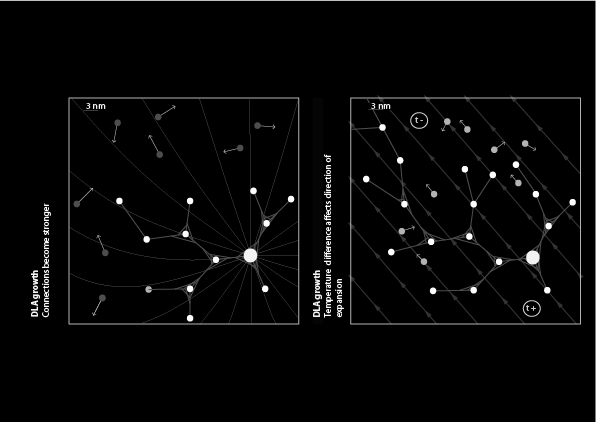
The supporting structure of the system is generated by a complex set of rules derived from the microscopic dendritic processes that occur in the formation of copper sulphate crystals. The emergent formations are never stable, but develop continuously over time, in a process of local self-regulation that produces a higly structured whole out of the interaction of simple parts.
This structure is then populated by a biological growth system inspired by the internal logic of a simple organism, the slime mold Physarum Polychephalum. This creates a complex network that self-stabilizes itself over the supporting crystals, translating the base geometry in a complex aggregation of folds, connections and bubbles.
The integration of the two systems gives rise to a multi-layered structure in which the supporting level of crystals expands itself in the organic system of the mold, creating an unstable formation continuosly changing and adapting to related modification.
_Crystal Structure - Diagrams of growth
_Slime Mold - Diagrams of growth
_Renders
_Growth video
Scripting elective - Tutor Alexander Kalachev - Dessau Institute of Architecture
Convergent Alchemies team: Keila Caldera, Clara Fonte Boa, Lila Panahi Kazemi, Andrea Rossi, Bogdana Ruteska, Matteo Taramelli, Daria Vernigora
Here you can find some pictures of our 3d printed model of the final project for Code in The Cloud design studio.
Soon pictures and renders from the final crits held yesterday.
Many many thanks to the guys of Reality Service for the super fast an good 3d printing.
The City and the City is a book about borders, about separation inside the body of the same city. It’s a book about the mental construction of a division between two cities that are actually the same one, but in the mind of the citizens are neatly separated and disconnected. It’s also a book about a murder, and due to that, about the complex thoughts connected with the search of the solution of this mystery of a death woman.
So, the two themes, which emerge from this book in terms of an inspiration for the search of a material behavior in nature, are:
- - The idea of the border itself, both as inside border and and outside one; the material logic associated with this are so the concepts of “membrane” and “skin”.
- - The complexity of the mental processes involved, that reminds to the study of complex neuronal networks and of the computational capabilities involved in the material behavior.
In order to find a material that can fit these two different characteristics, the attention must be driven more on the biological world that to the one of the inert materials. What is needed it’s a system defined by an articulated membrane, that works as a filter, able to perform some sort of computation and of “mental” process. Moreover, this system must be complex enough to show varied and interesting patterns of behavior over time, and simple enough in order to be observed and understood.
Material
"Slime Mold or Mould is a broad term describing protists that use spores to reproduce. Slime molds were formerly classified as fungi, but are no longer considered part of this kingdom. Their common name refers to part of some of these organisms' life cycle, where they can appear ad gelatinous slime." (Wikipedia)
These simple organisms, composed either of a single multi-nucleated cell or of a aggregation of different unicellular individuals, are always defined by the outer membrane and, despite they simplicity and their small dimension, they show a complex range of behaviors, ranging from environment sensing, to patterns recognition and networks optimization.
Between this group, one organism appears as particularly interesting: the plasmodium Physarum Polycephalum, a true unicellular slime mold that grows in shady and moist areas, avoiding light and feeding of the bacteria presents in the surrounding. This organism can grow really fast (up to 1cm/hour) and span up to many square meters, without ever losing its own integrity as single cell.
“Slime molds are no more than a bag of amoebae encased in a thin slime sheath, yet they manage to have various behaviors that are equal to those of animals who possess muscles and nerves with ganglia -- that is, simple brains.“ (John Tyler Bonner)
Behaviors
The movement of the Physarum is based on shuttle streaming, that means that is based on the movement of the protoplasm back and forth in the tube-like structure created in space. This pattern of movement is almost always regular, and is advocated as one of the main self-regulatory mechanisms of the organism itself.
The main characteristic of the behavior of the Physarum is its own ability of performing complex computations in different situations, always trying to find the most effective solution for the environmental problems that it faces. This ability allow the slime mold to sense the surrounding environment, creating and then optimizing complex networks of tubes in order to reach the different food sources, and even to balance between different nutrients in different times. Recent researches demonstrate that these simple organisms seem also able to some primitive form of memory, making previsions on the recurrence of regular events pattern over time.
Phisical Model
Magnetic fields have been chosen to try to reproduce the self-organization of the Physarum in a network of attractions and repulsions. The magnetic fields have been produced with self-made magnets, and the particle behavior of the slime have been approximated using iron filling. Unfortunately the experiment shows many differences from the processes that occur in the mold, mainly due to the omnidirectional diffusion of the magnetic fields, and for the directionality of the diffusion of the iron filling.
Digital Explorations
Between the different possible strategies to model the complex growth of the mold, we choose to use the agent-based modeling, both beacuse it seemed the best way to simulate the dynamics of the growth more than the patterns in themselves and beacuse it appeared as one of the most direct way to link this system of form production with some sort of behavior able to produce architectural systems.
A clear help in this choice come from the advices that we received form Jeff Jones, of the Institute of Unconventional Computing of Bristol, who is studyng this organism and the ways to reproduce it digitally for his PhD thesis.
“Furthermore, mastering the use of agent-based models to implement pattern forming processes is a necessary step with a view to designing distributed problem solving devices.“ (Eric Bonabeau)
The first test have been carried out in the direction of the simulation of a random growth of the structural pattern fo the mold based on swarming logic, and in particular on the Craig Reynolds' boids rules, as they have been coded by Jose Sanchez.
Strenght:
- Generally keeps the unity of the structure
- Simulates quite well the random growth
- Explores the whole space of search
Weakness:
- Relies more on parameters tuning than on coherent simulation
- It is complex to define optimisation functions
- Computationally quite expensive
The second script is still based on the same flocking algorithm, but improves that by adding a mesh able to keep track of the "chemoattractor" levels, that is a way of measuring the number of agents that have choos a location as part of their trail.
Stenght:
- Stores the growth trail as chemoattractant level
- Define a possible way to growth in 3 dimensions
- High degree of flexibility
Weakness:
- Still based on flocking simulation
- Chemoattractant values are not influencing the movement of agents
- Relies on scaling and limitation parameters
After this, in order to study the passage from random growth to network optimization, we added over the flocking simulation a physics engine, based on Toxiclibs, that we used to create a springs network between agents, that at certain points was then relaxed, causing the optimization of the network itself.
Strenght:
- Approximates simple patterns of optimized networks
- Allows the control of the process
Weakness:
- Breaks the unity
- Relaxation time too short to allow the emergence of complex patterns
- Based on springs not on convergence criteria
Finally, in order to explore the generation on more complex patterns and to use the chemoattractor levels to dinamically influence the emergence of networks, we starte to look into the complex world of ant algorithms, especially regarding the formation of foraging patterns in army ants colonies. In this fundamental for us have been the book Swarm Intelligence by Eric Bonabeau, Marco Dorigo and Guy Theraulaz.
Strenght:
- Records the chemoattractant trail and influences the movement of agents through it
- Based on scientific test
- Shows the emergence of complex optimized networks
Weakness
- Growth limited to two directions
- Relies on different optimisation system from slime mold
- Computationally expensive
Conclusions / Perspectives
The research we carried out give us a good knowledge and helped us to create digital tools useful for the next phase, when these systems of breeding of architectural form will be redirected and applied to a real environment and to a real program, in order to foster the emergence of new ways of occuping the space with architecture.
Our will for the next phases of the development of an architectural proposal is not to use these complex biological systems just to optimize a structure digitally in order to then build it as an inert element. We thrive for the creation of a real living architecture, able to mantain a continuous exchange of matter and energy between itself and the environment, abble to modify itself and adapt to the external and internal condition.
More then this, we want to investigate the construction of a new relationship between man and environment, in which the architecture becomes the medium to build a negotiation between the parts, more than a war between the human kind and the natural forces.
CodesInTheClouds design studio - prof. Liss C Werner
Dessau Institute of Architecture
Slime Mold team : Lila Panahi Kazemi, Andrea Rossi